Monday, January 17, 2011

Book on environment economics released

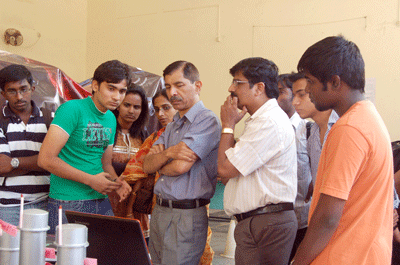
A book that provides a comprehensive discussion on environmental economics called ‘Economics of Environment’ was released here on Monday. Dr Subhashani Muthukrishnan, professor of Economics has authored the book.

Dr Chandrakant, professor and university head of Agriculture Economics and leader of the Centre of Excellence in Natural Resources at the University of Agricultural Sciences, Bangalore released the book.

Speaking on the occasion, Dr Chandrakant said, “It is not easy to write a book like this. The important issue here is that the book is written by an Indian and has been written in an Indian language that will help students to understand these environmental issues.”

“This book focuses on the welfare of the environment. It understands poverty and the environment and how people misuse resources at times,” he added.

The book deals with various aspects such as population and environment, market and environmental resources, degradation of the environment, sustainable development and various other environmental issues. It also deals with national and international environmental issues and legislations.


Making a presentation of the contents of the book, Dr Muthukrishanan, the author, said that the book discussed in detail the issue of market failure externality and welfare with regard to the environment. “The book has a detailed bibliography which encourages students to continue reading for the understanding of this subject. This book is for undergraduate and postgraduate students of economics.”

- Ainsly and Sarita, I M S Com

Friday, January 14, 2011

He has become a celebrity, at least for now

The sudden rise to celebrity status is putting Keshav Krishnamurthy, otherwise sedate studious student of III HEP, into an uneasy situation. His phone has not stopped ringing from the time people came to know about his rare feat of scoring 99.96 per cent in the Common Admission test (CAT).“Thankfully I had a breather of sorts today and I hope I will be left to myself,” said Keshav with a grin.

He was born in Bhubaneshwar, the capital city of Orrisa and moved to Bangalore with his family soon after his 12th class. “My father works in a software company and my mother is a teacher. We are all surprised over my result, because I had not really expected to score this much. I studied the last minute but I did take mock tests now and then which have probably been a lot of help,” said Keshav.

Maintaining a sense of calm over his recent success and the attention it has garnered, he said, “I am in a strange situation since. I am overwhelmed by everyone walking up to me with a warm smile and congratulating me. There is one more round of test left after which the admission procedure takes place.”


With the reporter

Speaking about Keshav’s Achievement, Vinay S S of III EPS said, “He is a very studious person. I see him always talking to teachers. He even has a good hold on English language. He has set an example for us. I am going to follow his footsteps and work harder from now on.”

“I knew very well, he had the potential to do well in life, but it was a surprise to see it happen so early. He would always ask good questions in class and involve actively in activities. I am very impressed with him,” said Dr P E Somaiah, lecturer of Political Science department.


The other teachers also seemed elated at his rare feat. “I knew he had to write CAT this year. He is a well read student and very curious to know about the text background. It was great news for the whole college,” said Dr Lata Radhakrishnan of Economics department.

- Raheeba, I M S Com

Thursday, January 13, 2011

Students taste traditional cuisines at Ahara Mela ‘10

In a world that thrives on fast food, the Kannada Sangha of SJC brought back the taste of traditional cuisine at a food fest held here on Thursday. Ahara Mela’ 10, as it was titled, the fest was full of mouth watering home made food items that were sold in record time.

There were nine teams who took part in the fest, and they brought food items cooked from home. Jolada roti, akki shavige, chandrahara, maddhur vade, vangibath were some of the items that were displayed. “This is organised every year, but this time we are conducting it in a bigger way and it’s our first step towards our mega fest Kanasu,” said Ravikiran, president of Kannada Sangha.

The food fest was conducted during the lunch hour and one could witness large number of students rushing in to savour their favourite dishes. There were also lots of traditional games such as kuntebille, chowkebara, pagadeyaata arranged to entertain the students.

“It’s nice to have food fests like this, as they bring in a lot of traditional culture to the limelight and my favourite is joladha roti with brinjal curry,” said Dr Beatrice, HOD of Microbiology department.

The most interesting part of the food fest was the exhibition of different models that depicted the everyday life of village people. Earthen vessels (mud toys) like grinder, stove, idli maker etc were showcased to give a glimpse of the traditional forms of cooking.


This fest is excellent and I’m very delighted to be part of it. All the food items are cooked exceedingly well by the students and I feel as if I am in my home town, having my granny’s preparations. Today’s generation forgets the traditional food and prefer fast food; so this is a nice way to bring students back to home made delicacies,” said Dr Poornima, lecturer of Kannada department.

- Maria Loveena, I M S Com

Wednesday, January 12, 2011

Students walk backwards for AIDS

Around 100 students from various departments and student associations such as National Social Service Scheme (NSS) and Josephs Aids Awareness Movement (JAAM) took part in the ‘AIDS awareness backwards march’ organised by JAAM. The march began from the campus and moved all the way till St Josephs Pre University College (SJPUC) on Residency Road.

“This has been the third consecutive year that this event is taking place. It was a very beautiful way in which this rally was executed in memory of Mrs Barbara Naidu who was the founder of JAAM. May her soul rest in peace,” said Dr Betty Daniel, department of Botany.


Students finally gathered at the SJPUC campus, formed a circle and sang melodious songs such as “Heal the world” and “We shall overcome”, along with a moment of silent prayer.

The organisers held that the backwards march signified the resolve that people must not show their backs to other people who are HIV positive.

Students held several placards which included slogans such as “AIDS is just a disease, not a curse” and “Let our motto be challenging, not escaping”.


The coordinator of the event, Renee D’Souza, from the department of Mathematics said, “So many students are now aware of AIDS and as they go out, they will spread the word and create more awareness.”

- Madhumita, I M S Com

Monday, January 10, 2011

Students exhibit innovative models at social-science fest

Ever thought of growing mushrooms in your backyard in a stack of hay, using helmets with LED lights, using your ordinary camera for high definition photography or visualising our city in the next ten years. These were some of the innovative ideas that the students demonstrated in campus at the Social and Science exhibition here on Monday. The two-day fest which began on Monday witnessed many participants with over 130 exhibits from the natural science and physical science departments, humanities section and the Hindi department.


One of the exhibits ‘ethno cultural plants from the North East’ had a variety of medicinal plants found in the North East region of the country. “We got the plants from our place and had a little difficulty in preserving them as they do not get adjusted to the Bangalore weather very easily,” said Thomas Tulgnung of II CBBT.

“Many people are not aware of our culture and traditions. By putting up an apparel stall we want the students to identify our culture and traditions. Apparel is a way for people recognise others and their cultures,” said Sonam, II BSW who was part of the Tibetan and North East apparel stall.


The exhibition showcased some very unique ideas like growing mushrooms in your garden, high definition photography, G-MET stall which showed how to connect your helmet to a global positioning system (GPS).


“It was very pleasant to see students putting in so much of effort and come up with so many innovative ideas. Even though their ideas may not work in the long run, to see students work so hard is very pleasing,” said Dr Koppikar, department of Chemistry.

- SANDRA AND LETITIA, I M S Com

This ‘Parliament’ session was sans boycotts and squabbles

It was a Parliament session; but unlike a typical Parliament session in the Centre, there were no shouting of slogans, no charging to the well of the House, no tearing of documents and, most importantly, no boycotts. Rather there was good discussion of issues, debates and a rare decorum followed with precision.


All this took place when the Political Science students of SJC came together to hold a mock session of the Parliament here on Monday, January 10.

The programme was inaugurated by Principal, Fr Ambrose Pinto. The major attraction of the event was that the students enacted the roles of President, Vice-President, Speaker, Prime Minister, Opposition Party members etc. Typical Parliament logistics were in place as the ruling and the opposition party members sat on either side of the House.


“For the first time in our country an indigenous Influenza A H1N1 vaccine is being developed which will be available this year,” said the President in his presidential address. He said that food security could be ensured only through sustained effort at increasing agricultural productivity combined with a comprehensive reform of the Public Distribution System and open market intervention. He also added that India should keep a constant watch and innovate against global terrorist groups. “My Government is committed in ensuring early passage of Women’s Reservation Bill which was introduced in the Rajya Sabha in May 2008. I would urge you to accord special attention to this critical proposal,” said the President, Keshav of III HEP.


Rise in food price, skyrocketing of onion and garlic price, people dying of cold weather conditions and left wing extremism in North-east part of the country were some of the issues that were raised during motion of thanks event. The Prime Minister (Vanissa, III EPS) and the Home Minister (Thejaswini, III HEP) responded to the questions saying that the rise in price of food items was everywhere in the world and it was the same in India as well. The Prime Minister also said that the present scarcity of onion was a creation by certain retailers who had hoarded large quantity of onion. He also added that Government had decided to avail services from the NGOs to rescue people who were suffering from extreme cold.


Regarding the Naxal issues, the Home Minister defended saying that the Government was holding discussions with all the groups, and in addition to this, the Government had also dispatched additional para-military forces to these states.


“The main objective of the event was to develop interest in national issues among the students. Next time when they read a news story with national importance, they would soon re-collect it as they have enacted it,” said P E Somaiah, programme coordinator and faculty member of Political Science department.

The students were found actively participating in the event. “It was a beautiful experience and we had the feeling that we were in the Parliament,” said Karthik of I EPS, a member of the model Parliament programme.

- Navami S, I M S Com

Media are unelected opposition leaders, opines Prof. Govind Rao

Are the media discharging their duties as expected of them? Are they being responsible at a critical time as these? What are the trends and opportunities available for young media aspirants in India today? These were some of the issues discussed and debated at the Outlook 2011- Media Matters, seminar held here on Saturday, January 8.

The seminar was organised by MOP Vaishnav College for Women, Chennai in collaboration with St Josephs College, Bangalore. The theme of the seminar was ‘Trends and Opportunities in Media’ and a number of speakers from a wide array of media related backgrounds shared their expertise on the subject matter.


Prof. G.K Govind Rao

The Chief guest for the event G.K Govind Rao, an actor and activist, in his inaugural address explored the role of media in a democracy. He said, “The media plays the role of an unelected opposition leader in a democracy. It should not be partisan. They must not take a stand for or against the party in power, but rather for the issue at hand.” He added, “The media has the dual role of providing knowledge and sharing experience. It should help the reader understand the past and visualise the future.”


Shedding light on the values that the media must propagate, he said, “The tenets of a democratic society include justice and equity. But for years, we have inherited feelings of superiority and inferiority. The media must mercilessly point out the kind of society we are trying to continue. The media must not cater to the audience’ taste, rather it should create new ones. It must help the youth think differently.”


Fr Ambrose Pinto, Principal of St Josephs College, who presided over the event, said, “There is a close nexus of the media with the corporate and political world. This marks the imminent death of the people’s media. The media today is communal, corrupt and commercial. What we should have in its place is a people-centric media which is concerned, compassionate and conscious.”


The speakers for the event were Prakash Belawadi, a journalist and film director, TNA Perumal, a wildlife photographer, Sourabh Panjwani, Post Doctoral Researcher working for Microsoft Research India and Sneha Iype, Executive producer, Nirvana Films. Each of these speakers shared the prevailing trends and presented the various opportunities that exist in their fields.

Prakash Belwadi

Students from colleges around the city such as Sri Bhagwan Mahaveer Jain College (SBMJC), Christ University, National College, Garden City College, St Josephs Evening College and Sri Sri Media Center were in attendance for the event. “The Seminar gave us a practical perspective of how the industry functions today,” said Firdouse from SBMJC.

- Parinitha, James, I M S Com